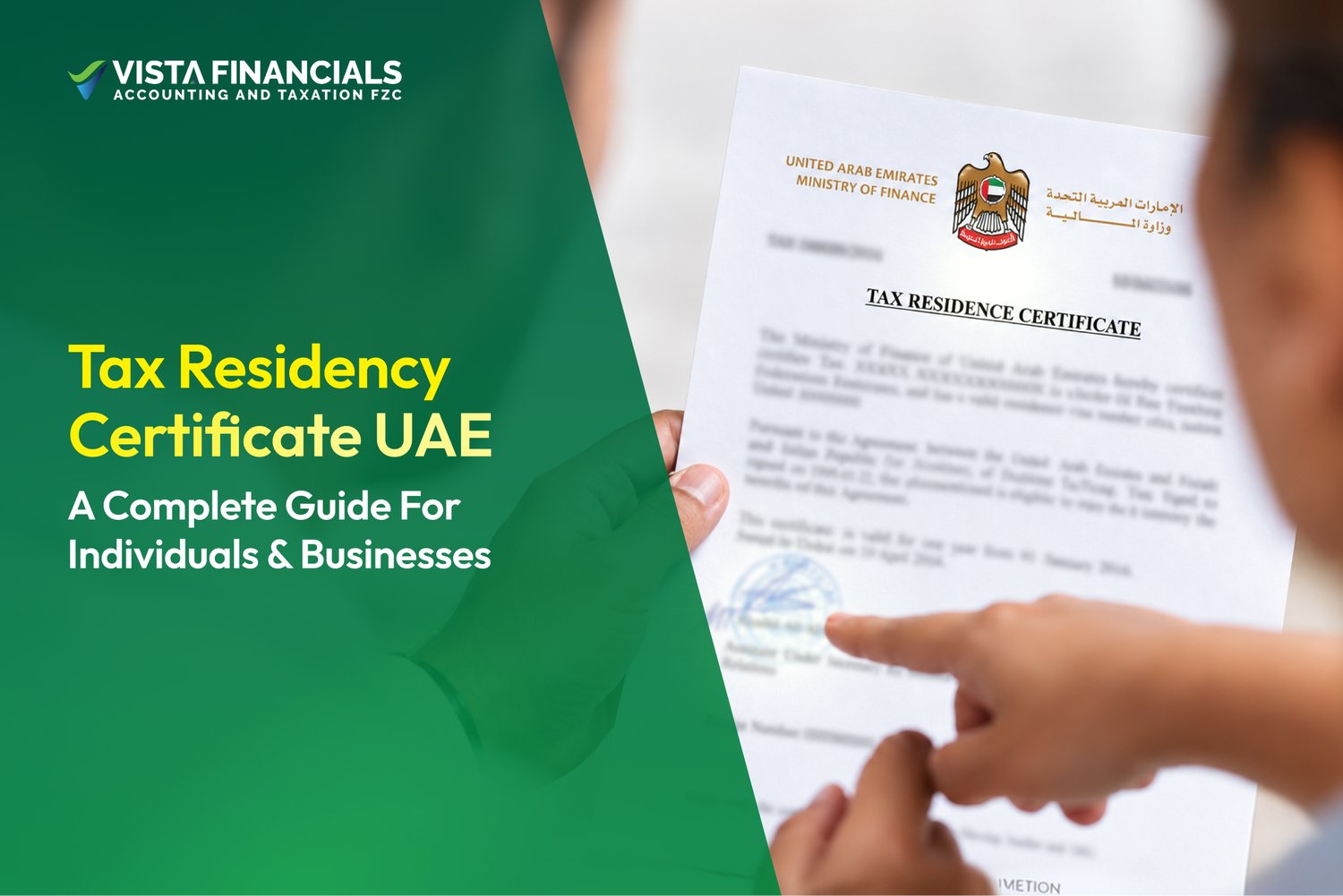
If you live in the UAE, run a UAE company or have financial interests in more than one country, you may eventually need to prove where you are tax resident.
A UAE Tax Residency Certificate (TRC) is the document issued by the Federal Tax Authority (FTA) to provide evidence of UAE tax residency for the relevant period. It is commonly used when a person or business needs to establish UAE tax residency for an applicable Double Taxation Agreement (DTA) or another tax-related purpose.
But there is an important distinction to understand from the start:
A UAE residence visa does not automatically mean you qualify for a Tax Residency Certificate, and a UAE TRC does not automatically remove tax obligations in another country.
So, how do you know whether you qualify? Which documents do you need? And what changes if you are applying for a company rather than yourself?
This guide breaks down the UAE Tax Residency Certificate process, eligibility rules, documents and practical considerations.
What Is a Tax Residency Certificate in the UAE?
A Tax Residency Certificate is an official certificate issued by the Federal Tax Authority confirming that a person is a tax resident in the UAE for the relevant period. It is also commonly referred to as a UAE tax domicile certificate.
A TRC can be requested by individuals and juridical persons, subject to the applicable requirements.
It is particularly relevant when UAE tax residency needs to be demonstrated in connection with an international tax agreement. The FTA describes the TRC as a certificate that enables applicants to benefit from applicable Double Tax Avoidance Agreements signed by the UAE.
For example, you may need a UAE TRC if:
- You receive income from another country
- You have investments or financial interests overseas
- Your business has international transactions
- A foreign tax authority asks you to prove your UAE tax residency
- You need documentary evidence to support a position under an applicable DTA
- You have recently relocated to the UAE and need to establish your tax residency position
The important point is that the TRC proves or evidences UAE tax residency; it does not itself determine how another country will tax you.
Who Can Apply for a UAE Tax Residency Certificate?
Both individuals (natural persons) and companies (juridical persons) can apply, but the eligibility basis differs:
- Individuals qualify based on physical presence, residence status, and — in some cases — where their main personal and financial ties are located.
- Companies qualify based on incorporation and, depending on the purpose of the certificate, how long they’ve been established.
This distinction matters throughout the process: the documents, the day-count rules, and even the eligibility test itself change depending on whether you’re applying as an individual or a company, and for what purpose.
How Many Days Do You Need to Stay in the UAE to Qualify?
This section covers individual eligibility. If you’re applying on behalf of a company, skip to “How Long Does a Company Need to Be Established?” below.
There’s no single day-count that applies to every situation — it depends on the route you qualify under and why you need the certificate.
For domestic UAE tax residency, individuals generally have three routes:
- 183 days or more of physical presence in the UAE during the relevant 12 consecutive months
- 90 days or more, combined with additional conditions
- A test based on your usual or primary place of residence and the centre of your financial and personal interests, where the relevant conditions are met
For a treaty-purpose TRC, the rule is narrower: the FTA’s current FAQ states that a natural person applying for a certificate for tax-agreement purposes must have been UAE resident for at least 183 days during the relevant financial year. Don’t assume the 90-day or interests-based domestic routes carry over to a treaty application — currently, they don’t.
So someone who’s spent 100–150 days in the UAE isn’t automatically excluded from all forms of UAE tax residency, but they may not qualify for a treaty-purpose certificate on that basis alone. Which route applies to you determines which documents you’ll need — covered in detail below.
How Long Does a Company Need to Be Established?
For companies, eligibility isn’t measured in days — it’s measured in incorporation status and, for treaty purposes, how long the company has existed.
For a domestic-purpose certificate, there’s generally no fixed minimum establishment period — a company incorporated or formed under UAE legislation is typically treated as UAE tax resident under Cabinet Decision No. 85 of 2022, subject to the applicable conditions.
For a treaty-purpose certificate, the bar is higher: the FTA’s current FAQ requires the legal person to have been established in the UAE for at least one year. A newly issued trade license, on its own, doesn’t meet this — regardless of how active the company already is.
One exception worth flagging: a branch registered in the UAE by a foreign company is specifically excluded from the standard incorporation route under Cabinet Decision No. 85 of 2022. If you’re operating as a branch, your tax residency position needs to be assessed separately rather than assumed.
What this means practically: a company’s eligibility basis (incorporation route vs. branch, domestic vs. treaty purpose, under or over one year established) determines which documents apply — covered next.
What Documents Do You Need?
This is where most of the confusion happens, because the “right” documents depend entirely on which route you’re relying on. Sending every document you have doesn’t strengthen an application — it can actually make the story less consistent if the evidence doesn’t point the same direction.
Is a UAE Residence Visa Enough to Get a Tax Residency Certificate?
No. A UAE residence visa is not, by itself, a universal guarantee that you qualify for a UAE Tax Residency Certificate.
A residence permit or visa can form part of the conditions for certain tax residency routes, particularly the 90-day domestic route. But the UAE tax residency framework also considers physical presence and, in applicable circumstances, usual or primary residence and the centre of financial and personal interests.
So these are two different questions:
Immigration question: Can you legally reside in the UAE?
Tax question: Are you a UAE tax resident under the applicable rules for the relevant purpose and period?
They may overlap, but they are not interchangeable.
Tax Residency Certificate – By Residency Route
If you qualify on 183+ days of physical presence
The application is primarily built on proving you were physically in the UAE.
- Passport and Emirates ID
- UAE residence visa or permit, where applicable
- UAE entry and exit report — this is the core piece of evidence for this route
- Proof of address or accommodation in the UAE
If you qualify on 90 to 183 days
Presence alone isn’t enough here — you need to show the additional conditions that support residency alongside the shorter stay.
- Entry and exit report covering the relevant period
- Evidence of a permanent place of residence in the UAE (tenancy contract, utility bills, title deed)
- Proof of employment or business activity in the UAE
- Proof of income or source of income
If you qualify on under 90 days, or on centre of interests
This route depends on demonstrating where your life is genuinely centred, not just where you slept.
- Evidence of a permanent UAE residence
- Evidence supporting your centre of financial and personal interests — this can include employment or business records, investment documentation, family or dependent visa records, and evidence of ongoing UAE-based activity
- Any documentation that ties your day-to-day financial and personal life to the UAE rather than another country
The common thread across all three routes: your evidence should match the specific basis you’re claiming, not just demonstrate general UAE presence.
Company Eligibility & Documents
For a domestic-purpose application, a company typically needs:
- Trade license
- Certificate of incorporation, where applicable
- Memorandum or constitutional documents
- Corporate Tax registration details, where applicable
- Proof of authorised signatory
For a treaty-purpose application, the bar is higher — and this is the part most often under-documented. In addition to the above, current FTA guidance can require:
- An audited financial report for the relevant financial year
- A UAE (or local) bank statement covering six months within that financial year
These two items are frequently the difference between a straightforward treaty-purpose approval and a request for additional information. If your company’s financials aren’t audited, or your bank records don’t cleanly cover six months of the stated financial year, that’s worth resolving before you submit — not after the FTA asks for it. .
What Is the Centre of Financial and Personal Interests?
This is the least intuitive part of the framework, and it’s not a checklist — it’s a “where does your life actually sit” question.
Relevant factors include:
- Where you work or run your business
- Where your investments are located and managed
- Family and social ties
- Memberships, associations, and ongoing activities
Having some interests outside the UAE doesn’t disqualify you — the question is where those interests are, on balance, closest and most significant.
This is exactly why it’s assessed holistically rather than by counting assets on either side.
Domestic-Purpose vs Treaty-Purpose TRC: What Actually Differs
| Domestic-purpose TRC | Treaty-purpose TRC | |
| Applies to | UAE domestic residency rules | An applicable Double Taxation Agreement |
| Individual day-count | 183+, 90–183, or interests-based route | 183 days minimum, currently — no shorter route |
| Company establishment | No fixed minimum period | At least one year of UAE establishment |
| Extra documentation | Standard corporate/residency documents | Audited financials + 6-month bank statement (company); treaty context matters for individuals |
Decide which one you need before you start the application — the FTA’s system asks you to select a purpose, and that choice shapes what you’re expected to submit.
Should you prepare every possible document?
Not necessarily.
A stronger approach is to first determine which eligibility route and application purpose apply to you, then collect documents that directly support that position.
Think of the documents as evidence, not as a box-ticking exercise.
If the information across your passport, Emirates ID, corporate records, residence evidence and other supporting documents does not tell a consistent story, simply uploading more documents will not necessarily solve the problem.
How Do You Apply for a Tax Residency Certificate in the UAE?
You apply for a UAE TRC electronically through the FTA’s EmaraTax platform. The FTA states that the Tax Residency functionality can be accessed through the Other Services section.
The process generally involves the following steps.
Step 1: Log in to EmaraTax
Existing users can log in using their EmaraTax credentials. New users need to create an account.
Step 2: Open the Tax Residency service
Access the Tax Residency functionality through Other Services.
Step 3: Select the applicant type
The application distinguishes between applicant categories, including natural persons and juridical persons.
Step 4: Select the purpose and relevant period
This is one of the steps that deserves particular attention.
You need to identify why you require the certificate and the relevant financial year or period.
The FTA’s guidance states that the start date of the required financial year cannot be a future date.
Step 5: Enter the required information
Provide the applicant and residency information requested by the FTA.
Step 6: Upload supporting documents
Upload the documents relevant to your applicant type, purpose and eligibility basis.
Before submitting, check that:
- Names and identification details are consistent
- The relevant financial year is correct
- Physical presence evidence supports the stated period
- Company information matches current records
- Documents support the purpose selected
Step 7: Pay the applicable FTA fees
The application is subject to the applicable FTA service fees.
Because government service fees can change, check the amount displayed by the FTA when submitting the application rather than relying on an old article or fee table.
Step 8: Wait for FTA review
The FTA’s current FAQ states that it will take up to five working days to review the application. This is a review timeline, not necessarily a guarantee that every application will be fully completed within five working days, particularly if additional information is required.
Step 9: Download the certificate
Once approved, the certificate can be downloaded through the FTA’s system.
In practice, most of the work — and most of the risk — sits in steps 4 and 6: choosing the right purpose and period, and matching documents to the correct residency basis. A mismatch at either point is usually what leads to delays. Because of this, many applicants prefer to have the application prepared and submitted on their behalf rather than working through it directly on EmaraTax. Vista Financials Accounting and Taxation handles this process end to end, from confirming the right route through to submission and follow-up with the FTA.
How Much Does a UAE Tax Residency Certificate Cost?
The total cost of a UAE TRC application isn’t a single fixed number — it depends on whether you’re applying as a registered or non-registered individual or company, and whether you need a printed copy in addition to the digital certificate. The FTA structures its fees around a submission fee plus a separate certificate fee, and the certificate fee is where the cost varies most.
As a general guide, applicants can expect the total cost to fall in the low-to-mid four-figure AED range, with non-registered applicants — particularly non-registered companies — typically paying more than registered ones.
Because FTA fees are periodically updated, and the correct fee depends on your specific applicant category, it’s best to confirm the exact amount at the time of submission rather than budgeting against a fixed figure.
How Long Does a UAE Tax Residency Certificate Take?
Processing time of a Tax Residency Certificate depends on how complete and consistent your application is from the outset. A well-prepared application — correct residency route, matching documents, accurate financial year — tends to move through review considerably faster than one that prompts the FTA to come back with questions.
As a general expectation, straightforward applications are typically reviewed within about a week, though this isn’t a guarantee for every case. If the FTA requests clarification or additional documentation — which is more common with treaty-purpose or company applications — the process can take noticeably longer.
If you’re working toward a foreign filing deadline, a treaty claim, or any date-sensitive requirement, it’s worth starting the process well in advance rather than close to the deadline. Getting your residency basis and documentation right the first time is the biggest factor in avoiding delays — something our team Vista Financials Accounting and Taxation can help you get right before you submit.
Does a UAE TRC Mean You Do Not Have to Pay Tax in Another Country?
No — and this is where a TRC is most often misunderstood. Whether you have tax obligations in another country depends on that country’s domestic rules, the relevant DTA, and your specific facts.
This question comes up most often for:
- UAE entrepreneurs with overseas income — royalties, consulting fees, or business income earned from clients or operations abroad
- UAE residents receiving foreign investment income — dividends, rental income, or capital gains from assets held outside the UAE
- People relocating to Dubai who still maintain a home, employment, or family ties in their previous country
- Business owners with companies across jurisdictions, where profits, directors, or operations span more than one country
- Anyone who needs to prove UAE residency to an overseas tax authority — often as part of a treaty claim or to stop being treated as tax resident elsewhere
In each case, the practical need is the same: the TRC has to be backed by documentation that matches the residency basis being claimed, and it has to be considered alongside the foreign country’s own residency and tie-breaker rules — not treated as a standalone exemption.
If two countries could both claim you as tax resident, the applicable DTA’s tie-breaker provisions determine treaty residence. The TRC is important evidence in that analysis, but it’s one input, not the conclusion.
When Should You Get Professional Tax Advice?
A straightforward domestic application — clear UAE presence, no foreign income, no treaty involved — is often manageable without outside help.
You should get professional advice before applying if any of the following apply to you:
- You’re applying for a treaty-purpose certificate, where the documentation bar is stricter and a foreign tax authority will be reviewing the outcome
- You have overseas income — from clients, investments, rental property, or a foreign business
- You’ve recently relocated to the UAE and still have unresolved ties (home, employment, family) in another country
- Your company operates across multiple jurisdictions, or profits and directors sit in more than one country
- Your company was recently established and you’re unsure whether it meets the one-year threshold for a treaty-purpose application
- You’re not sure which residency route applies to you, or which documents match that route
In each of these cases, the risk isn’t usually rejection — it’s applying under the wrong basis, with documents that don’t quite support it, and losing time to a follow-up request. Getting advice before submitting is what actually prevents that, rather than advice after something’s already gone back to you for clarification.
Final Thoughts
A Tax Residency Certificate application is not simply a matter of counting days and uploading a passport.
The important questions come first: Why do you need the certificate? Which residency criteria apply to you? What period does it cover? And what evidence supports your position?
For someone dealing only with UAE domestic requirements, the analysis may be relatively straightforward. Once another country, overseas income, a second residence or a Double Taxation Agreement enters the picture, the details become more important.
That is where a structured approach can save time and prevent you from applying with the wrong purpose, period or supporting evidence.
If you need help assessing your tax strategy, preparing the relevant documentation or navigating the UAE TRC application, Vista Financials Accounting and Taxation can help you work through the requirements with your wider tax position in mind. Reach out for a free consultation today.